By Andrea Van Unen-Smith, Chief Marketing Officer, Senetas
Since AUSA 2026 in Washington DC, one message from the show floor keeps coming back to me: defence technology is being adopted faster than ever, and the security foundations underneath it must keep pace.
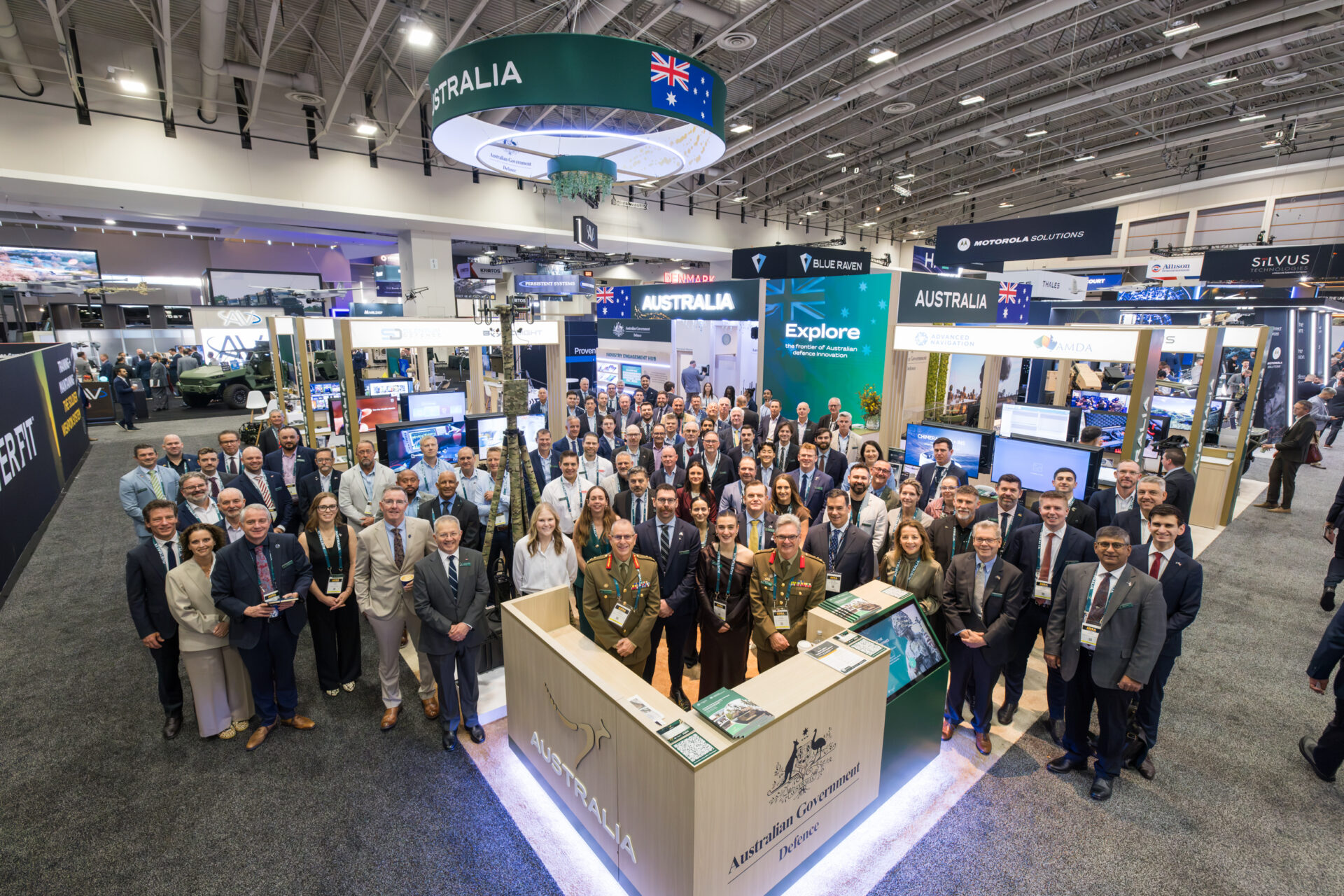
It was my first AUSA. Senetas exhibited on the Australian Pavilion as part of the Team Defence Australia delegation, supported by Austrade, alongside Australian innovators who genuinely punch above their weight. Across three days, conversations centred on autonomous systems, AI, post-quantum cryptography (PQC), resilient communications and next-generation command and control.

Autonomy is moving from experiment to operations
On day two, the US Army’s acting Chief of Staff, Gen Christopher LaNeve, announced that Futures and Concepts Command had been redesignated as the Army Futures and Autonomous Systems Command (FASCOM). It was a clear signal of how quickly autonomy is moving towards operational use.
Autonomous capabilities depend on trusted data moving between platforms, sensors, command systems and distributed networks. The more connected and autonomous those environments become, the more it matters that data in motion is protected, and that the people relying on it remain in control of that protection.
Starlink: a real-world lesson in control
Satellite connectivity was one of the hottest topics on the floor, with Starlink regularly cited as proof of how commercial technology has changed the modern battlefield. None of us expected that conversation to become so real, so quickly.
Within the same month, SpaceX placed a speed limit on Starlink terminals in motion in Ukraine, without advance notice to the military. That cap was later lifted, but in November restrictions returned on Starshield, the militarised version of the service, cutting connectivity for equipment moving faster than 161 km/h. Ukrainian officials have said the limits are affecting interceptor drone operations.
The lesson for defence organisations is not about any one provider. It’s that capability built on infrastructure you do not control can change overnight. Whatever the bearer, whether fibre, radio or satellite, the encryption protecting sensitive data should stay under the operator’s own control, and be able to adapt as conditions change.
Open architecture meets legacy reality
Integrating new capabilities without abandoning infrastructure already in service was another strong theme. Open systems architecture was positioned as central to the Army’s modernisation, allowing new hardware and software to be introduced as technology and threats evolve. Integration is not always smooth, though: bringing newer command-and-control technology onto existing communications systems creates real challenges.
That is the reality of defence modernisation: new platforms must coexist with legacy infrastructure, allied systems and technologies with very different lifecycles. Cryptography cannot stay fixed while everything around it changes. Defence organisations need to be able to update algorithms and security controls without replacing entire networks or disrupting mission-critical operations. That is crypto-agility.
The US post-quantum timeline is now set
PQC was not the headline theme of AUSA, but it dominated the conversations at our booth. Visitors wanted to know what the US deadlines really mean, and what they should be doing now.
Under the US government’s PQC migration mandate, federal agencies must transition their high value assets and high-impact systems to PQC in two stages:
- 31 December 2030: PQC for key establishment (encryption).
- 31 December 2031: PQC for digital signatures (authentication).
Defence is moving on the same timeline. The US Department of War’s Post-Quantum Cryptography Strategy requires all systems to support PQC, or be phased out, by 31 December 2030, and to use PQC by 31 December 2031 unless otherwise specified.
Two weeks after AUSA, NIST published the final version of its transition report, NIST IR 8547. It goes further than the draft: RSA and elliptic curve cryptography at every approved key size are now deprecated after 2030 and disallowed after 2035. There is no longer a “stronger key” route to buying more time.
The practical deadline is earlier than you think
The real deadline is not the day a cryptographically relevant quantum computer arrives. It is the point at which information encrypted today still needs to stay secure. With “harvest now, decrypt later”, adversaries can collect encrypted traffic today and wait. Meanwhile, much of the network equipment in service now will still be operating well into the post-quantum era.
For defence networks with long operational lifecycles, getting ready today is what keeps you compliant, and secure, in 2030 and beyond.
Ready to take the first step? Read our 5-step guide to quantum security.